How Plastic-Jacketed Metal Conduit Is Made
See how steel strip becomes a flexible metal core, then receives an outer plastic jacket. Includes a 61-second animation of the manufacturing process.
· · 5 min read + 1 min video
Quick answer
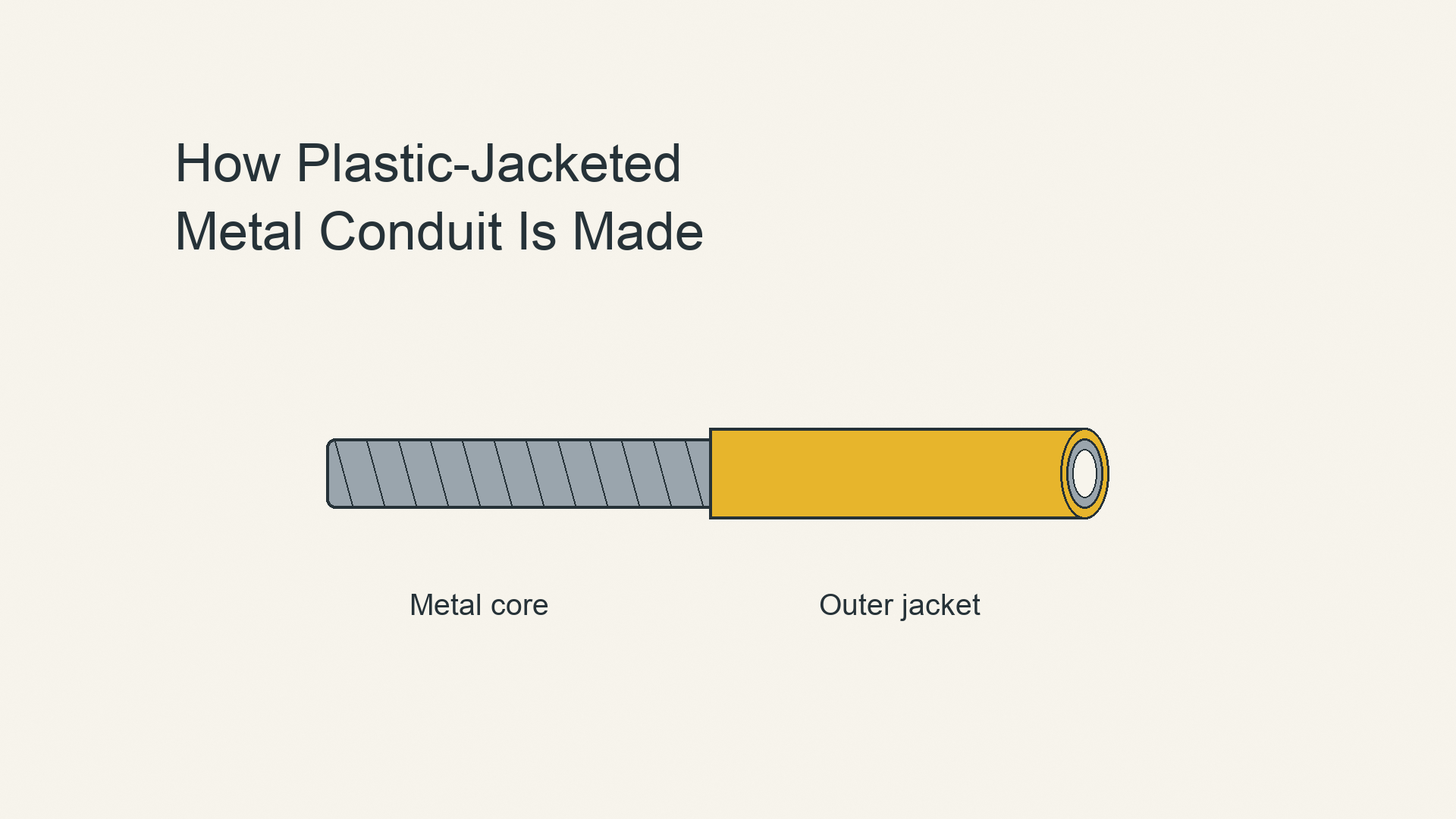
The metal core comes first. Steel strip is shaped, wound into a helix and interlocked to make a hollow tube. A selected plastic compound is then extruded around the outside, cooled and wound onto a reel after haul-off and inspection. The bore stays open for cables or fibers.
Watch the 61-second manufacturing overview
Read the video transcript
An interlocked metal core provides protection. The plastic jacket covers its outside, leaving the passage open. Options include PVC, PE, polyurethane, and low-smoke, zero-halogen compounds. These are alternatives. TPU is a thermoplastic polyurethane option. First, inspect the steel strip. Form its interlocking profile, then helically wind and interlock it into conduit. Inspect the bare conduit before coating pay-off. Prepare the jacket compound according to its grade requirements. Heat and extrude it around the moving metal conduit, keeping the passage open. Cool the jacket externally, then use haul-off to draw the conduit onward. Inspect and wind it onto a reel. Finally, carry out batch inspections as required. TongFeng. Choose the jacket for your application.
The animation follows ten stages of making stripwound conduit for cable and fiber protection. It uses simplified drawings to explain the process, including the forming tools and the inside of the extrusion head. Pressure-carrying corrugated hose needs a different specification.
Steps 1–3: Form and inspect the metal core
1. Inspect the steel strip. Before forming, check the strip against the production specification for material, dimensions and surface condition. Use the acceptance limits in that document.
2. Form, wind and interlock. Forming tools shape the strip profile, then the strip winds into a helix. Adjacent turns engage to make the flexible tube. The selected construction determines the profile.
3. Inspect the bare conduit. Check the core before jacketing. The drawing may call for checks on bore, metal outside diameter and profile condition. This is the point to catch a core defect before an outer layer covers it.
Steps 4–6: Feed the core and apply the jacket
4. Pay off and guide the core. The bare conduit feeds from a reel toward the extrusion head. Guides control its route through the line.
5. Prepare the jacket compound. Select the compound for the order, then prepare it to the requirements of that grade. PVC, PE, PU and LSZH are jacket options. TPU is a thermoplastic polyurethane option, so a specification that says only “PU” still needs a precise compound designation.
6. Extrude the outer jacket. Heated compound flows around the moving metal conduit and forms the covering. It stays outside the core. Control the jacket to the finished drawing, especially where outside diameter affects the fit of a clamp, fitting or equipment opening.
Steps 7–10: Cool, draw, inspect and wind
7. Cool the jacket externally. In the video, water cools the newly applied covering before the conduit reaches the haul-off. Cooling settings depend on the compound and conduit size.
8. Draw the conduit onward. The haul-off pulls it through the line. Coordinate the feed, extrusion and take-up for the specified jacket, with line speed set for the compound and conduit size.
9. Inspect and wind. Check the finished conduit, then wind it onto a reel. The inspection plan defines the dimensional and surface checks needed at this stage. Handle the conduit so it remains suitable for the next assembly operation.
10. Carry out the batch checks. Use the inspections required for the order. Sampling rules, acceptance limits and any claimed rating need to be supported by the inspection documents and batch records. The animation explains the sequence; it does not supply those results.
Choose the jacket by grade and environment
TongFeng’s product literature lists PVC, PE, PU and LSZH jacket options. Start with the exact compound grade. A family name alone does not tell you whether a jacket will suit the working temperature, movement or chemical exposure of your installation.
- Give the normal working temperature and any short-term temperature exposure.
- State the bend radius. Explain whether the route stays fixed, bends repeatedly or twists.
- Describe the environment, including moisture, outdoor exposure, oils, cleaning agents or other chemicals.
- For an IP requirement, identify the conduit, fittings and seals to be evaluated together.
| Jacket option | What the name means | What to confirm |
|---|---|---|
| PVC | Polyvinyl chloride compound | Grade, working temperature and compatibility with the actual exposure |
| PE | Polyethylene compound | Grade, installation conditions and required environmental performance |
| PU / TPU | Polyurethane family; TPU is a thermoplastic polyurethane option | Exact compound designation and the required bend and exposure conditions |
| LSZH | Low-smoke, zero-halogen compound category | Applicable smoke and halogen test requirements, plus evidence for the selected product |
Keep the three diameters separate
The bore, bare metal outside diameter and jacketed outside diameter describe different parts of the conduit. Put all three on the drawing when they matter to the fit. The added jacket changes the finished outside diameter.
A cable bundle has to pass through the conduit and its terminations, and the finished conduit has to fit the surrounding equipment. Check both routes. A nominal size cannot replace the actual dimensions, tolerances and measurement condition.
Send the details needed for a useful quotation
If you already have a specification, send the model or drawing. Add the length and quantity if known, along with the jacket grade and any dimensional limits that affect assembly.
If you need help choosing, describe the application first. Give the working temperature, bend radius and operating environment. A cable or fiber-bundle size, movement pattern and fitting interface will help TongFeng review the metal core and jacket as one assembly.
Frequently asked questions
Does the plastic fill the inside of the conduit?
The process shown applies plastic around the outside of the metal core. The bore stays open for cables or fibers.
Are PVC, PE, PU and LSZH mixed together?
These are alternative jacket categories. The list is not a recipe for mixing all four. Prepare the selected compound according to its grade requirements.
Does a jacket make every conduit waterproof?
A jacket alone does not establish an IP rating. The exact conduit, fittings, seals and installation need to be evaluated together, with test evidence for that configuration.
Does the animation show an exact factory-machine design?
It shows the manufacturing sequence. Forming and extrusion-head details are schematic, and some equipment is simplified. Use approved production documents for machine setup and acceptance requirements.