SquareLock vs Fully Interlocked Flexible Conduit
A conditional comparison of two commercial stripwound profiles and the product data needed for a defensible selection.
· · 6 min read
Quick answer
SquareLock and fully interlocked are commercial descriptions for different stripwound profiles. Their names do not define identical geometry or guaranteed performance across manufacturers. Select an exact product from its profile drawing, material, strip thickness, dimensions and verified test data.
SquareLock and fully interlocked at a glance
| Requirement | SquareLock-style candidate | Fully interlocked candidate | Evidence needed |
|---|---|---|---|
| Compact routing and bending | Screen where an engaged stripwound profile may suit the route. | Screen when the exact profile and route geometry remain acceptable. | Approved profile drawing plus part-specific installation and, where applicable, dynamic bend limits. |
| Crush or axial load | Do not infer a load rating from the construction name. | May be evaluated when the project defines a load requirement. | Matched material, size, specimen, test method, load and acceptance result. |
| Repeated movement | Construction name alone does not establish cycle life. | Construction name alone does not establish cycle life. | Representative route, bundle, clamps, speed, torsion, environment, target cycles and failure criteria. |
| Ingress or outdoor exposure | The metal profile alone does not establish an IP or outdoor rating. | The metal profile alone does not establish an IP or outdoor rating. | Documented covering, fittings, seals, installation method and separate environmental evidence. |
Define the exact profile first
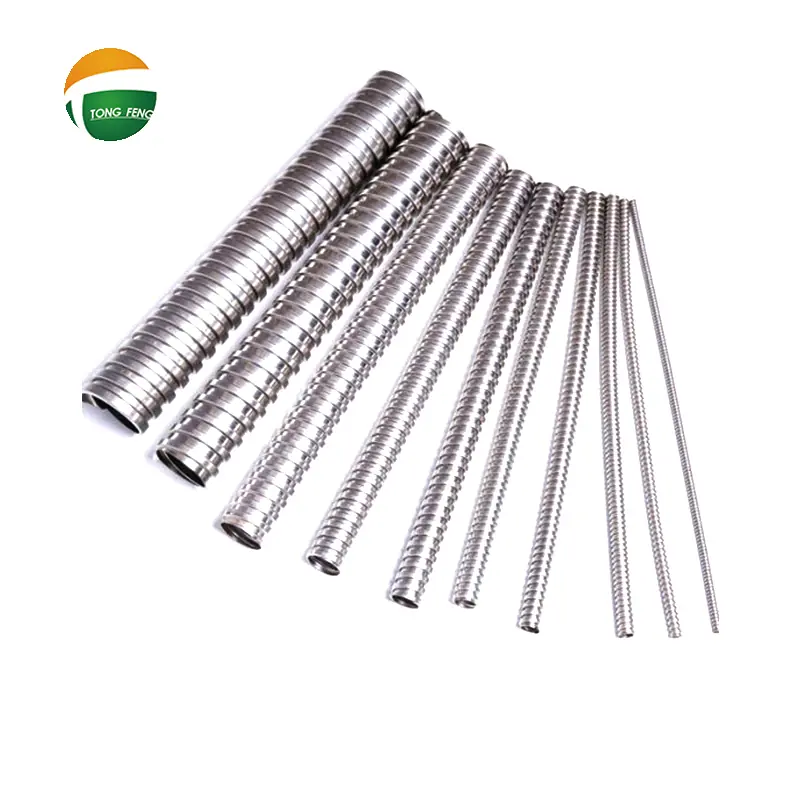
In this guide, SquareLock refers to the engaged or overlapping stripwound profile shown on the applicable TongFeng drawing. Fully interlocked refers to a profile in which the strip edges are further interlocked. The approved cross-section drawing controls the final definition.
With comparable materials, strip thicknesses and sizes, a SquareLock-style profile may offer easier bending. A fully interlocked profile may be selected for specified transverse crushing or axial pull requirements. These are selection tendencies, not guaranteed rankings.
Choose by the dominant requirement
- For compact routing, confirm the product-specific permissible installation radius and, where motion is present, a separately validated dynamic bend radius.
- For crushing or axial pull loads, agree the specimen, comparable size, test method, load and pass criteria before comparing constructions.
- Where moisture or ingress protection is required, select and test a complete sheathed conduit and matched fitting system.
- For chemicals, abrasion, smoke or flame performance, specify the exact compound and applicable test separately.
Information that prevents a wrong selection
Provide the required bore or I.D., metal-tube and finished O.D., tolerances, route length, bend geometry, movement pattern, expected loads, environment, covering and fittings.
For critical motion or load cases, agree the specimen length, bend geometry, load, speed, environment, cycle count, inspection intervals and pass or fail criteria before representative testing.
Frequently asked questions
What is SquareLock flexible conduit?
SquareLock is a commercial description for an engaged or overlapping stripwound metal profile. The approved cross-section drawing, material, strip thickness and dimensions define the actual product.
Is fully interlocked conduit always better?
No. Under comparable size, material and test conditions, it may provide greater resistance to specified crushing or axial pull loads. Other requirements can favor a different construction.
Can either construction have a sheath?
A covering can be evaluated for the selected product. Material, thickness, finished dimensions, fittings and any ingress or fire-performance claim must be confirmed as one documented configuration.
Does SquareLock construction make a conduit waterproof?
No. An ingress claim requires evidence for the complete conduit, covering, fittings, seals and installed interface under stated test conditions.