Flexible Metal Fiber Protection Tubes
Project-specific flexible protection for optical-fiber routing in compact equipment.
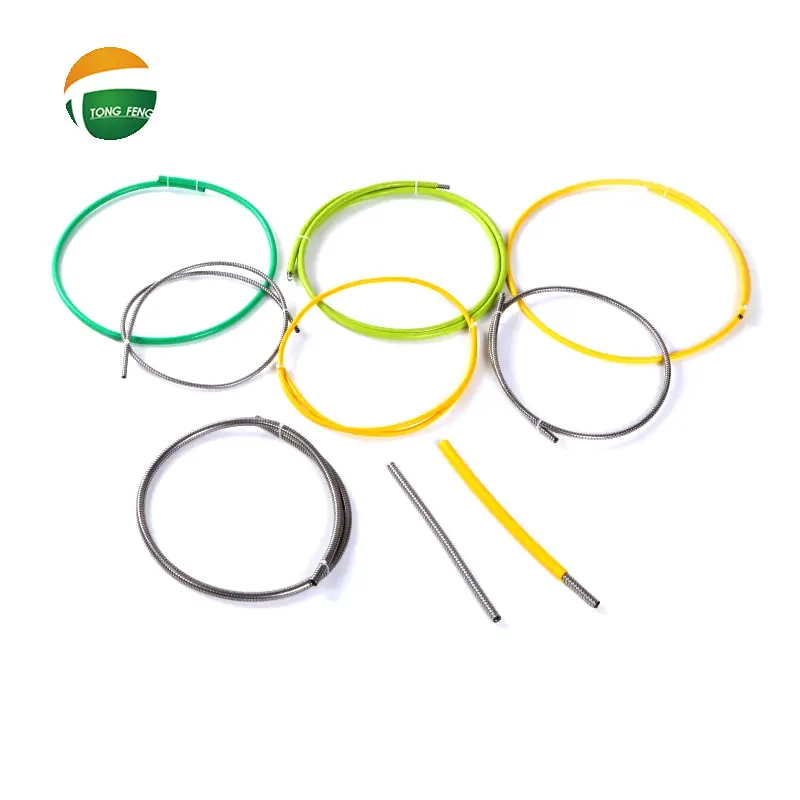
Fiber-protection tubing can be reviewed for endoscopes, laser systems, sensors, precision measurement and communications equipment. Confirm the controlled drawing, pass-through requirement, inner-surface condition, bend limits, covering and terminations for the exact assembly.
Product highlights
- Controlled drawing required for final dimensions
- Pass-through and tolerance confirmed per part
- Covering and termination options reviewed per project
- Assembly-level qualification remains required
Specifications
| Type | I.D. (mm) | O.D. (mm) | O.D. + sheath (mm) |
|---|---|---|---|
| TF1829D | 1.8 | 2.9 | 4.0 |
| TF2234D | 2.2 | 3.4 | 4.4 |
| TF2638D | 2.6 | 3.8 | 4.8 |
| TF3050D | 3.0 | 5.0 | 6.0 |
| TF040070S1F1 | 4.0 | 6.0 | 7.0 |
| TF050076S1F2 | 5.0 | 7.0 | 7.6 |
| TF060092S1F3 | 6.0 | 8.0 | 9.2 |
| TF080110S1F2 | 8.0 | 10.0 | 11.0 |
| TF100130S1F2 | 10.0 | 12.0 | 13.0 |
Selection checklist
- Completed fiber or cable bundle diameter
- Minimum I.D. and maximum finished O.D.
- Static, repeated-flex or torsional movement
- Sheath, water resistance and termination requirements
Typical applications
- Medical endoscopes
- Laser systems
- Fiber-optic sensors
- Precision measurement
Frequently asked questions
What inside diameters are available?
Published catalog dimensions are reference values only. Confirm current availability, tolerances and the approved drawing before quotation or design release.
Why are tube O.D. and sheathed O.D. both shown?
The metal tube and finished sheathed assembly interface with different parts of the device, so both dimensions matter for routing and termination.
Are these tubes suitable for a finished medical device without further testing?
Component selection does not replace device-level validation. The customer should confirm regulatory, cleanliness, material and performance requirements.